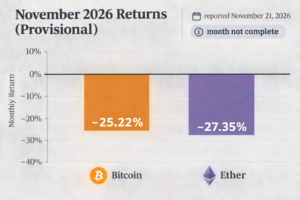
A 120-day moving average measures the average of Bitcoin’s recent prices. It can mark where a previous pullback stopped, but it cannot establish where the next one must stop. That distinction ran through a SmartX discussion reported on November 18, 2026, as three market participants weighed whether Bitcoin’s sharp decline was a bottom or part of a continuing bear market.
David, SmartX’s founder and CEO, described a fall from roughly $78,000 to about $62,000—or $61,900—in less than a week. He argued that the move was not simply long-position liquidations or a deterioration in Bitcoin’s fundamentals. In his view, institutions facing pressure in AI stocks may also have sold liquid assets, including Bitcoin, to raise cash. He pointed to inflation and expectations of tighter monetary policy as further pressure on liquidity. Those were his explanations and expectations, not established causes or enacted rate increases.
The trader identified as 链研社 said the decline continued past a level near $75,000 where, by his reading of the prior cycle, the 120-day moving average might have provided support. He interpreted the later weakness as Bitcoin catching up with macroeconomic and US-stock-market pressure. The failed support level illustrates the limit of the comparison: a historical pattern described what happened before, not a floor this time.
Three readings of a possible bottom
链研社 was watching roughly $62,000 as a potential second bottom, after an earlier low near $57,000. He said a sustained hold in the $64,000–$62,000 area would strengthen that case, while stressing that it remained unverified. His other checks included funding rates, open interest, the Coinbase premium, stablecoin flows and Bitcoin ETF flows. He said the premium was normalizing, but stablecoin and ETF outflows were still a source of pressure.
David was less ready to call a cycle reversal. He said the broader cycle remained intact but the market was still in a bear phase; in his view, more than a month of sideways trading in the $60,000s followed by a rise would make a reversal more convincing.
老白 put the greatest weight on Bitcoin’s approximate four-year cycle and considered the area around $60,000 a probable bottom range, not an exact price. He also cautioned that many indicators he had drawn from one cycle failed in the next. His cycle comparison is therefore a rough timing framework, not a backtested guarantee or proof that Bitcoin cannot fall further.
The speakers differed on what would confirm a bottom, but none presented $62,000—or any other level—as certain. A moving average, a prior cycle and the indicators 链研社 listed each describe a different part of market behavior. None, on its own, resolves what comes next.