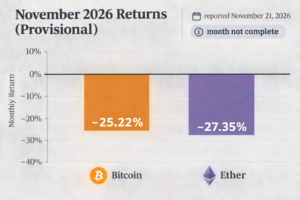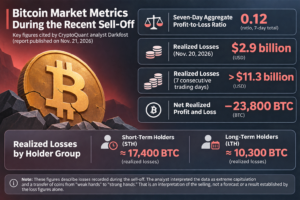
HTX Research’s six-month outlook, reported on November 20, 2026, centers on a question a price chart alone cannot answer: after November’s leveraged positions were cleared, would new cash buyers step in? The report identifies $62,000–$66,000 as a recent buyer cost zone for Bitcoin, but treats stabilization there as a possibility to test—not a price floor or forecast.
Price recovery versus incoming capital
According to the report, total crypto market capitalization rose 39.6% quarter over quarter in the third quarter, while spot trading did not expand in step. Citing Farside, it says U.S. spot Bitcoin ETFs recorded $2.579 billion in cumulative net outflows from November 2–17. Citing DeFiLlama, it says stablecoin market capitalization had fallen 5.33% over the preceding 30 days as of November 18.
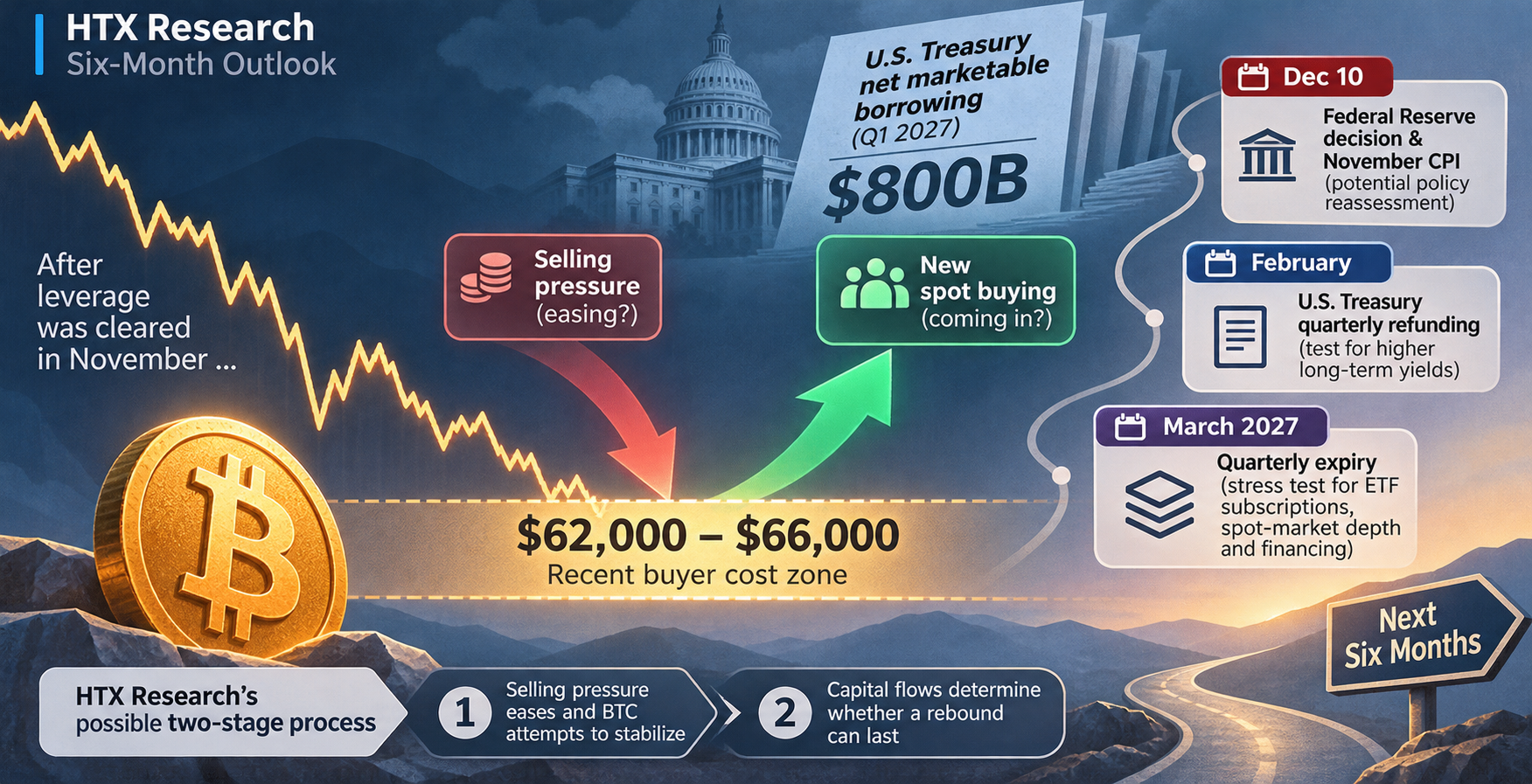
Those measures describe different parts of the market; none, on its own, establishes whether buyers will defend the reported cost zone. HTX Research expects a possible two-stage process: selling pressure eases and BTC attempts to stabilize, then capital flows determine whether a rebound can last.
The report’s tests for a rebound
HTX Research argues that financing conditions over the following six months may matter more than any single rate decision. It points to the U.S. Treasury’s projected $800 billion in privately held net marketable borrowing for the first quarter of 2027. If more issuance falls at longer maturities, the report says, higher long-term yields could make financing less favorable; it identifies February’s quarterly refunding as a test of that possibility. It also flags December 10, when it says a Federal Reserve decision and November CPI release are due, as a potential moment for rapid reassessment of the policy path.
Institutional demand is not automatic, either. The report says narrower share-price premiums and costlier financing could reduce prospective Bitcoin purchases by listed treasury companies even if they do not sell existing holdings. It cites roughly $240 million of ETF net outflows on November 17—about eight times its estimate of that day’s new Bitcoin block subsidies by nominal value. That comparison conveys scale, not a direct measure of how ETF flows affect price.
The report’s proposed test comes on pullbacks: whether each decline brings fewer forced sellers and whether rebounds draw more spot buying. It points to the March 2027 quarterly expiry as a potential stress test for ETF subscriptions, spot-market depth and financing conditions. A quick bounce alone would not establish that capital has returned; if the recovery relies mainly on short covering and renewed leverage, HTX Research says the cost zone could be tested again.