Sygnum’s forecast starts with a capital-flow assumption, not a Bitcoin price chart. In its 2027 Sygnal outlook, released on November 19, 2026, the Swiss digital-asset bank estimated that a rotation from technology stocks into digital assets could lift Bitcoin to nearly $128,000. The report gave no timetable and described that figure as the result of its calculations, not a price target.
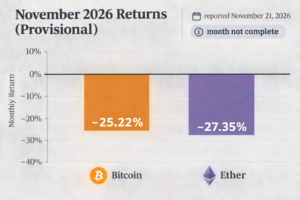
As reported on November 20, 2026, Bitcoin was trading near $63,000 after six consecutive weeks of declines and a move below its 200-week moving average. Sygnum characterized the roughly 54% drawdown as Bitcoin’s shallowest bear market to date, compared with declines exceeding 70% in previous cycles. It expected digital assets to enter 2027 with lower structural volatility and stronger fundamentals, while warning that a sell-off in AI stocks could spill into crypto.
What drives the estimate?
Sygnum put the digital-asset market’s value at about 6% of Nasdaq’s. In its scenario, approximately $36 billion flowing into crypto—equivalent to 0.75% of Nasdaq’s market value—could raise the sector’s total value by more than 60% and bring Bitcoin near $128,000. That is a conditional estimate: it depends on the assumed inflow and its modeled market impact, neither of which establishes when or whether the move will occur.
The report also projected that Bitcoin could shift from a tactical portfolio holding toward a “strategic reserve” asset competing with gold for capital seeking protection against currency depreciation. Sygnum said BlackRock, Morgan Stanley and Bank of America had each recommended allocations of 1% to 4%. It estimated Bitcoin’s market value at roughly 6% of gold’s and calculated that an inflow equal to 1% of gold’s market value could increase Bitcoin’s market value by at least 17%. That comparison, too, is a flow-based scenario rather than a guaranteed price response.
Beyond Bitcoin, Sygnum expected Ether to reach a new high but said overall market gains would remain concentrated. It reported stablecoin supply near $298 billion and tokenized real-world assets above $39 billion at the end of October. Its other forecasts included Visa’s on-chain stablecoin settlement volume tripling to $60 billion by the fourth quarter of 2027, and spot-long, futures-short carry trades outperforming U.S. Treasuries. Chief investment officer Fabian Dori said volatility had not disappeared but had shifted from assets to market infrastructure, while institutional adoption continued to build.