
Bitcoin’s mining difficulty measures how hard it is to find a block; hashprice estimates the daily dollar revenue earned by a unit of computing power. Neither is a direct measure of a miner’s profit. To assess that, miners also need to account for the Bitcoin price, electricity, equipment and other costs.
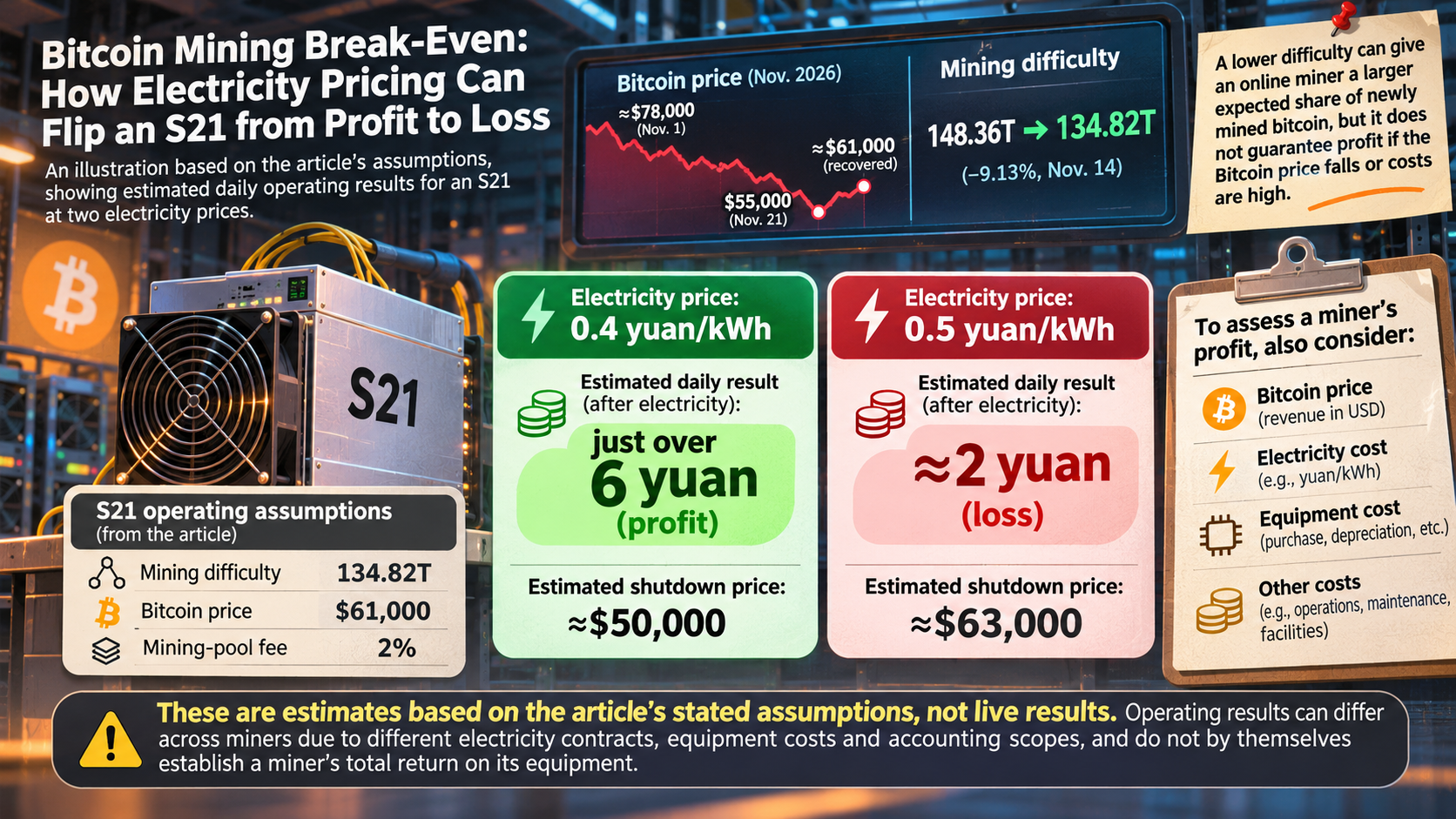
As reported on November 23, 2026, those measures were pulling in different directions. Bitcoin had fallen from about $78,000 at the start of November to a November 21 low of $55,000, before recovering to around $61,000. Mining difficulty fell 9.13% on November 14, from 148.36T to 134.82T. That gave a machine that stayed online a larger expected share of newly mined bitcoin, but the price decline could still leave its dollar revenue lower.
The reported hashprice illustrates the squeeze: it stood at $28.50 per PH/s per day on November 22, down 21% from a month earlier. The article says it briefly reached $26.20 the previous day, below the prior $27.70 low recorded in June.
A cost line is not the same for every miner
Citing MARA’s financial reports, CryptoQuant founder Ki Young Ju estimated its operating cost at $62,862 per bitcoin mined, including $39,674 for electricity. On that accounting basis, a roughly $61,000 Bitcoin price was below its estimated cost. The article also cites CoinShares’ estimate of approximately $75,500 in average cash cost per bitcoin for listed miners. These are company-level estimates with different accounting scopes, not a universal price at which mining stops.
The machine-level examples make the sensitivity clearer. Using difficulty of 134.82T, a $61,000 Bitcoin price and a 2% mining-pool fee, the article estimated that an S21 could earn just over 6 yuan per day after electricity at 0.4 yuan per kilowatt-hour, but lose about 2 yuan per day at 0.5 yuan. Its estimated shutdown price rose from roughly $50,000 to $63,000 across those two electricity rates. A more efficient S23 was estimated to remain profitable at 0.5 yuan per kilowatt-hour, though the article noted its higher purchase cost. These operating calculations do not by themselves establish a miner’s total return on its equipment.
What a falling difficulty can—and cannot—signal
Difficulty adjusts every 2,016 blocks. If miners switch off, a subsequent downward adjustment can improve the expected bitcoin output of machines that remain online. It cannot guarantee that the improvement offsets a lower Bitcoin price or higher costs. Nor does a difficulty decline establish a market bottom.
The article described another possible complication: some mining companies were directing power and facilities toward AI computing. Citing CryptoQuant, it said Bitcoin production across IREN, Core Scientific, Bitfarms, TeraWulf and Cipher was 47% lower in January–October 2026 than in the same period a year earlier. It also reported that Bitfarms had announced a plan to phase out Bitcoin mining over two years in favor of AI data centers. A production decline alone does not quantify how much computing power has permanently left Bitcoin mining.
That distinction matters when interpreting a mining-cycle chart. Difficulty, hashprice and shutdown-price estimates describe changing conditions; they do not reveal every company’s electricity contract, equipment costs or alternative use for its facilities. Historical episodes in which miner shutdowns preceded price rebounds are not, on their own, a predictive rule.