November 23, 2026, at 19:42:38 (UTC+08:00)
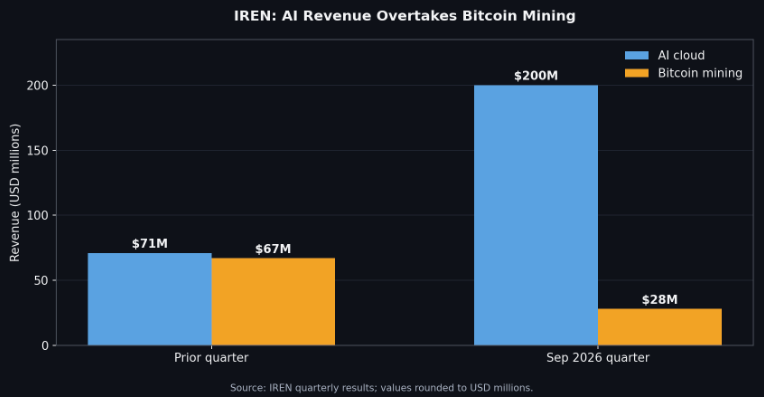
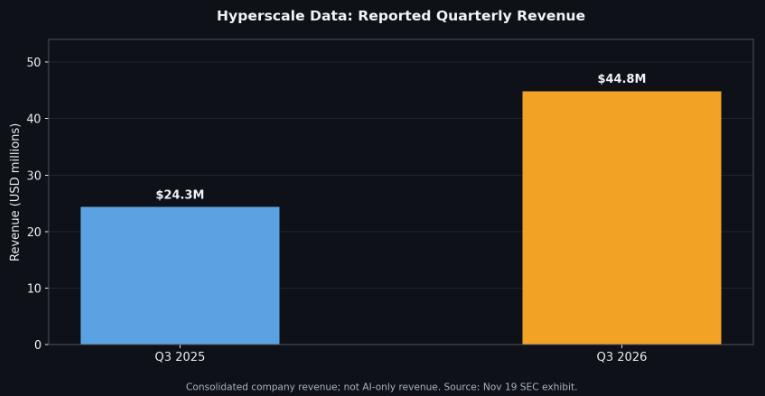
IREN earned approximately $200 million from AI cloud services in the quarter ended September 30, compared with $28 million from Bitcoin mining. Hyperscale Data’s third-quarter figure measures something different: its $44.8 million was consolidated revenue across the company, not revenue from AI services. Hyperscale had stopped mining at its Michigan site but still needed financing to convert it into an AI data center.
IREN reports operating capacity; Hyperscale targets a rollout
IREN’s AI cloud revenue rose roughly 182% from $71 million in the previous quarter, while its mining revenue fell from approximately $67 million. The company has been converting mining facilities to support AI training and inference. By the end of September, it reported approximately 93 megawatts of operating AI cloud capacity. In an SEC filing, management said it expected to substantially complete the shift away from Bitcoin mining by December 31, 2026, with only immaterial mining operations continuing into 2027.
Hyperscale’s consolidated revenue rose 84% from the third quarter of 2025. Mining at its Michigan site ended on September 1. The company planned to deploy 20 megawatts of AI computing capacity there, targeting the first 10 megawatts for December 2026 and the remainder by the end of March 2027. Those figures were deployment targets, not operating capacity.
In its November 19 financial announcement, Hyperscale confirmed that it had sold its remaining Bitcoin holdings, approximately 211.6 BTC, for around $16 million in November. The proceeds went primarily toward repaying debt and supporting the conversion. A substantial funding gap remained. Hyperscale was scheduled to discuss its results and infrastructure plans on a November 23 investor call.
What the conversions tell us about Bitcoin’s hashrate
Revenue measures what a company earns, and megawatts measure power capacity. Neither figure measures Bitcoin’s network hashrate, the rate at which miners collectively perform mining calculations. The conversions show that AI operators and Bitcoin miners compete for reliable electricity and suitable sites. Earlier in 2026, StandardHash founder Leon Lyu warned that competition for electricity was already changing mining economics.
If enough computing power leaves Bitcoin mining, the network’s difficulty can fall at a subsequent adjustment. Bitcoin adjusts difficulty approximately every 2,016 blocks to keep the average block interval near ten minutes. A lower difficulty can improve the economics for miners that remain and attract new operators, but it does not guarantee that departing hashrate will be replaced. That depends in part on electricity costs and mining profitability.
Hyperscale’s treasury sale is distinct from its decision to stop mining in Michigan. The sale made existing coins available to buyers; it did not change Bitcoin’s issuance schedule or its maximum supply of 21 million coins. Likewise, the two companies’ decisions show how individual operators are reallocating power, not whether Bitcoin’s total hashrate will rise or fall.