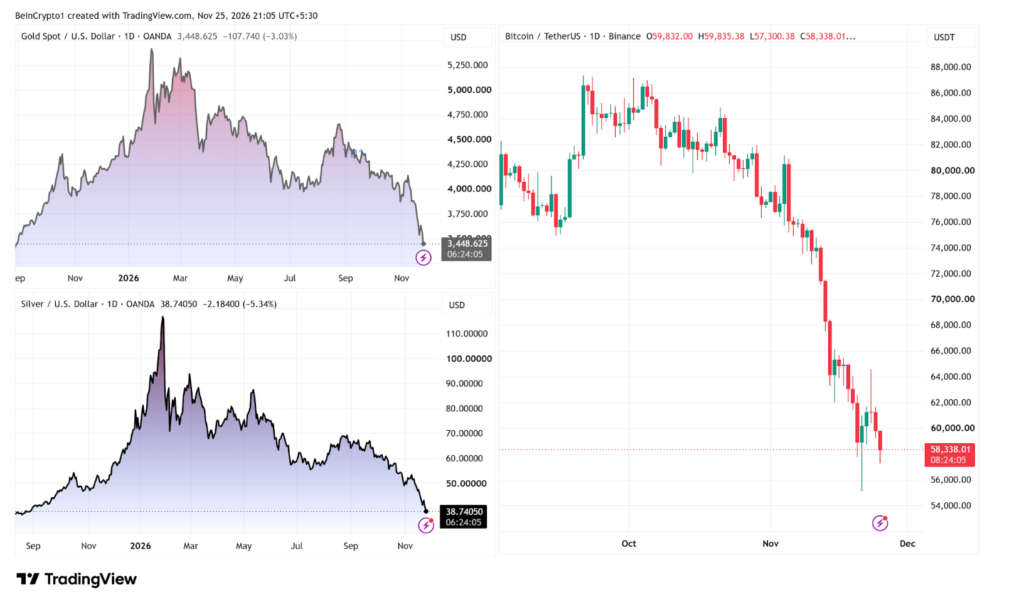
The US personal consumption expenditures (PCE) price index, the Federal Reserve’s preferred inflation gauge, rose 3.8% in October from a year earlier, up from 3.7% in September. Bitcoin, gold and silver all fell after the November 25, 2026 release. The three assets pay no interest, and futures traders expected the Fed to raise rates again in December.
Annual inflation rose as monthly price growth slowed
October was the 68th consecutive month that inflation exceeded the Fed’s 2% target. The annual PCE reading matched forecasts, but core PCE, which excludes food and energy, rose to 3.3% from 3.1%, above the 3.2% estimate. The monthly readings told a different story: headline prices rose 0.3%, down from 0.5% in September, while core price growth held at 0.3%.
The government also revised third-quarter GDP growth from a 3.4% annual pace to 4.3%, above the 3.5% forecast. White House economic adviser Kevin Hassett called it a “Goldilocks” economy. He expected more quarters of 4% growth and further upward revisions to GDP. Inflation, he said, was “maybe a little bit above target” but “not accelerating at all.”
Income rose 0.7% in October, helped by one-time Medicare premium rebates. According to the Bureau of Economic Analysis, disposable income rose 0.5% after inflation. Spending rose 0.3%, below the 0.4% forecast and down from 0.6% in September. After inflation, spending was flat.
Futures pointed to a second rate increase
The November 25 account cited a 97.8% futures-implied probability of a rate increase on December 9. That was a market expectation, not a Fed decision. Separately, BeInCrypto reported on November 12 that traders had fully priced in a December hike following hotter October inflation figures.
Under Chair Kevin Warsh, the Fed had raised rates in September for the first time in three years, despite President Donald Trump’s calls for cuts. Fed Governor Christopher Waller told CNBC on November 18 that a half-percentage-point increase was probably necessary. Hassett said on November 25 that he expected Warsh and the Fed to base their decision on the data.