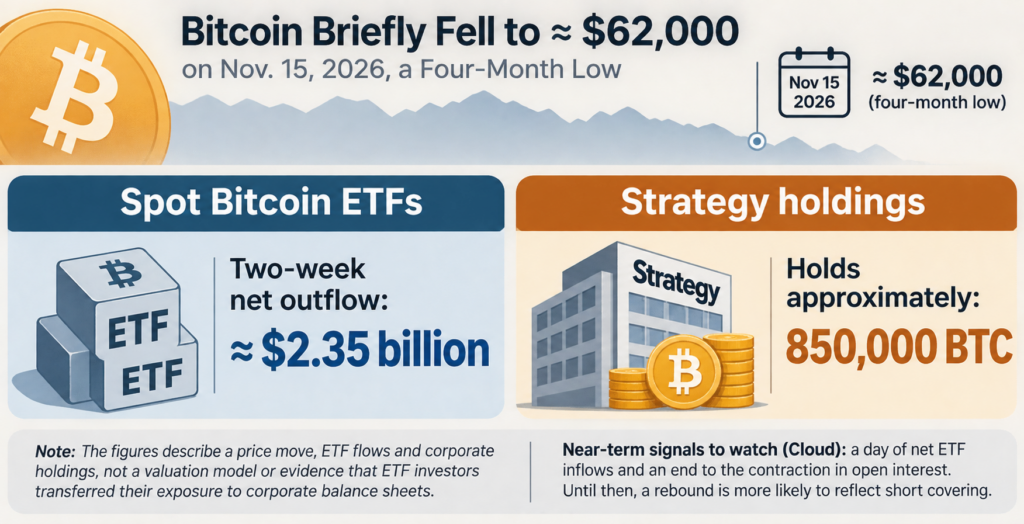
The figures in this report describe a price move, ETF flows and corporate holdings—not a valuation model or evidence that one group of investors bought what another sold. As reported on November 16, 2026, Bitcoin briefly fell to about $62,000 on November 15, its lowest level in four months.
Huobi HTX chief analyst Cloud argued that the decline reflected three downward shifts in what investors were willing to pay, rather than a collapse in demand. In Cloud’s account, a stronger-than-expected October CPI reading pushed back expectations of easier monetary policy: a December rate increase was fully priced in, the probability assigned to a 50-basis-point increase reached 15.3%, and the 2027 rate-setting schedule had narrowed to seven meetings. Cloud also cited roughly $2.35 billion in cumulative net outflows from U.S. spot Bitcoin ETFs over two weeks.
Cloud said MSCI would remove Strategy from its Global Standard Indexes on November 30, potentially creating passive selling pressure on Strategy shares, not directly on Bitcoin. At the sentiment level, Cloud also claimed that Nvidia CEO Jensen Huang had resigned and argued that AI and crypto had shared a source of risk appetite over the preceding two years. The supplied report does not independently establish that resignation.
As a counterpoint to ETF outflows, Cloud cited Strategy’s holdings of approximately 850,000 BTC and BitMine’s 6.07 million ETH. Cloud also pointed to an Ethereum staking rate of 36.3% and a record average of 2.16 million mainnet transactions per day. Those holdings and activity figures do not, by themselves, demonstrate that ETF investors transferred their exposure to corporate balance sheets.
For the near term, Cloud identified a day of net ETF inflows and an end to the contraction in open interest as signals to watch. Until then, Cloud considered a rebound more likely to reflect short covering. That is an analyst’s interpretation, not a forecast established by the figures above.