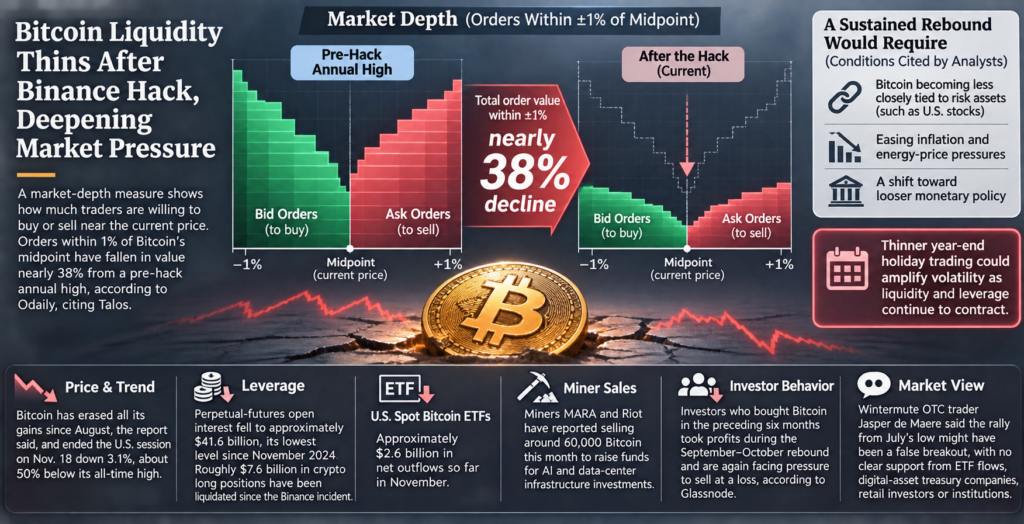
A market-depth measure shows how much traders are willing to buy or sell near the current price. In a report dated November 19, 2026, Odaily said the total value of Bitcoin orders within 1% of its midpoint had fallen nearly 38% from a pre-hack annual high, citing data from Talos. Thinner order books can make large trades move prices more sharply; the measure does not, by itself, predict where Bitcoin will trade next.
Bitcoin had erased all its gains since August, according to the report. On Wednesday, November 18, it briefly fell below $63,000 and ended the U.S. trading session down 3.1% at $62,267—about 50% below its all-time high. The report linked the weakness to declining risk appetite, shrinking liquidity and the impact of what it described as a major Binance hack.
Leverage was also contracting. Bitcoin perpetual-futures open interest had fallen to approximately $41.6 billion, its lowest level since November 2024. The report said roughly $7.6 billion in crypto long positions had been liquidated since the reported Binance incident.
Demand indicators offered little offset. U.S. spot Bitcoin ETFs had recorded approximately $2.6 billion in net outflows so far in November. The report also said miners MARA and Riot had reported selling around 60,000 Bitcoin this month to raise funds for AI and data-center infrastructure investments. Citing Glassnode, it said investors who bought Bitcoin in the preceding six months had taken profits during the September–October rebound and were again facing pressure to sell at a loss.
Wintermute OTC trader Jasper de Maere said the rally from July’s low might have been a false breakout, with no clear support from ETF flows, digital-asset treasury companies, retail investors or institutions. Analysts cited in the report said a sustained rebound would require Bitcoin to become less closely tied to risk assets such as U.S. stocks, alongside easing inflation and energy-price pressures and a shift toward looser monetary policy. Those were conditions they identified, not a forecast. They also warned that thinner year-end holiday trading could amplify volatility while liquidity and leverage continued to contract.