Spain’s financial intelligence unit, Sepblac, would be able to freeze a crypto account for up to five business days without first obtaining a court order if it finds indications of money laundering or terrorist financing. A separate limit of ten business days would apply to an individual transaction still in progress.
Royal Decree-Law 44/2026, dated November 24, 2026, appeared in Spain’s Official State Gazette on November 25. The powers are scheduled to take effect on January 25, 2027, subject to parliamentary validation. Article 86 of the Spanish Constitution requires royal decree-laws to be submitted to Congress within 30 days of promulgation.
When a court order becomes necessary
The new Article 46 bis of Spain’s anti-money laundering legislation would let Sepblac act on its own analysis. According to the government’s explanatory memorandum, Sepblac could previously use this particular preventive power only at the request of a foreign financial intelligence unit.
The five-business-day limit covers accounts and business relationships; the longer limit applies only to pending transactions. Both are ceilings: Sepblac must lift a restriction sooner if it is no longer necessary. At the applicable deadline, the suspension expires unless a court confirms or extends it at the request of public prosecutors. Spain’s criminal procedure rules govern appeals against that judicial decision.
A suspension preserves funds for investigation. It does not confiscate them or establish wrongdoing. Article 46 bis protects Sepblac, its officials and employees, and institutions that comply with its orders from liability when they carry out a suspension lawfully. The article itself does not specify a detailed mechanism to compensate customers for losses, including those a business might incur if it cannot use the funds to settle payments.
What can actually be frozen?
An exchange or custodian can block withdrawals because it controls access to the crypto it holds for customers. Bitcoin has no central administrator that can disable an ordinary address, and the decree creates no such capability. That technical limit does not put self-custodied bitcoin beyond the reach of other lawful procedures.
Some centrally issued stablecoins work differently: their issuers can restrict transfers. Blockchain security firm Beosin found that approximately $722 million in USDT and USDC was frozen across 1,397 addresses on Ethereum and Tron between March and April 2026. Those figures illustrate an existing issuer capability, not freezes under the Spanish decree.
The European enforcement context
Spain’s reform implements elements of the EU’s 2024 anti-money laundering directive, which sets common requirements for national financial intelligence units. The directive describes temporary suspensions as a way to preserve funds while investigators assess whether their suspicions are justified.
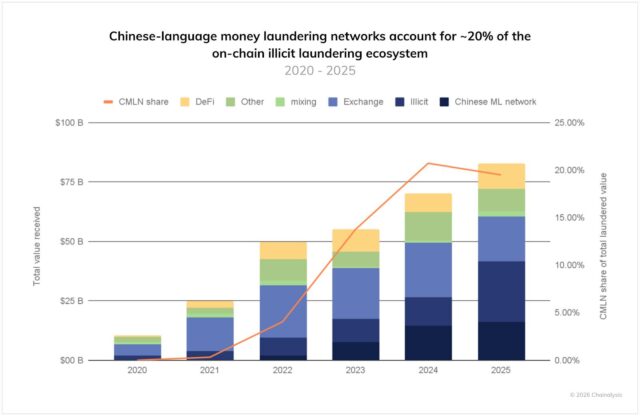
Global on-chain money laundering volume rose from $10 billion in 2020 to more than $82 billion in 2025. Those figures describe activity worldwide, not its scale in Spain. The next step for the Spanish measure is parliamentary validation.