As reported on November 19, 2026, Bitcoin had fallen back near $62,000 for the second time in days. The question was not whether a chart had identified a floor, but whether buying demand could withstand expectations of further Federal Reserve rate increases.
Rate expectations behind the sell-off
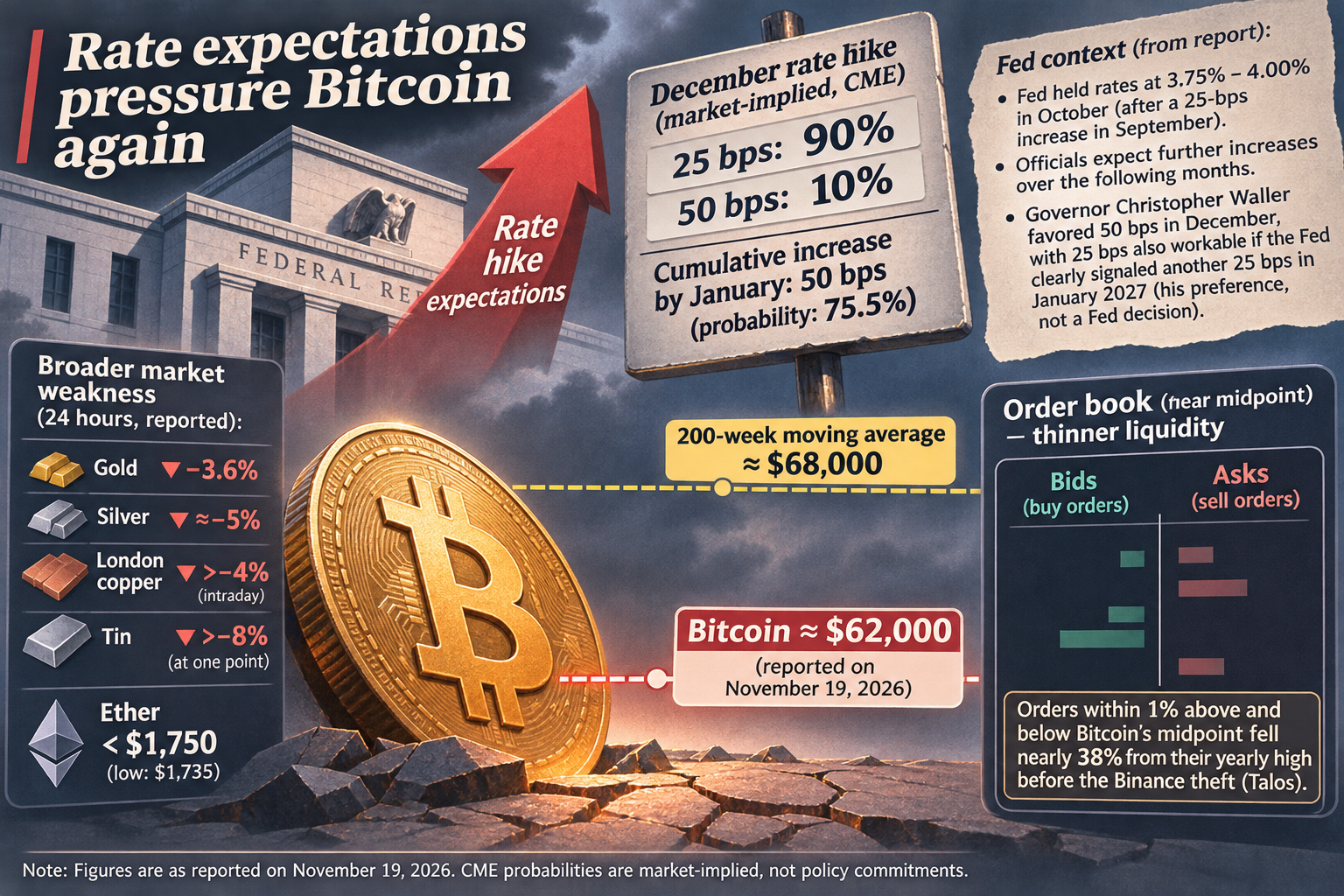
The weakness extended beyond crypto: Ether fell below $1,750, briefly reaching $1,735, while spot gold lost 3.6% and silver about 5% over 24 hours. London copper fell more than 4% intraday, and tin more than 8% at one point.
Fed Governor Christopher Waller told CNBC that inflation was moving in the wrong direction and price pressures had spread to services. He favored a 50-basis-point increase in December but said a 25-basis-point move could work if the Fed clearly signaled another 25 basis points in January 2027. That was his preference, not an announced Fed decision.
Minutes of the Fed’s October 2026 meeting showed disagreement over pace. After a 25-basis-point increase in September, the Fed held rates at 3.75%–4.00% in October; Governors Lisa Cook and Cleveland Fed President Beth Hammack dissented in favor of an increase. Nearly all participants expected further increases over the following months if the economy developed as anticipated. Two raised the possibility of a December increase greater than 25 basis points if subsequent inflation data disappointed.
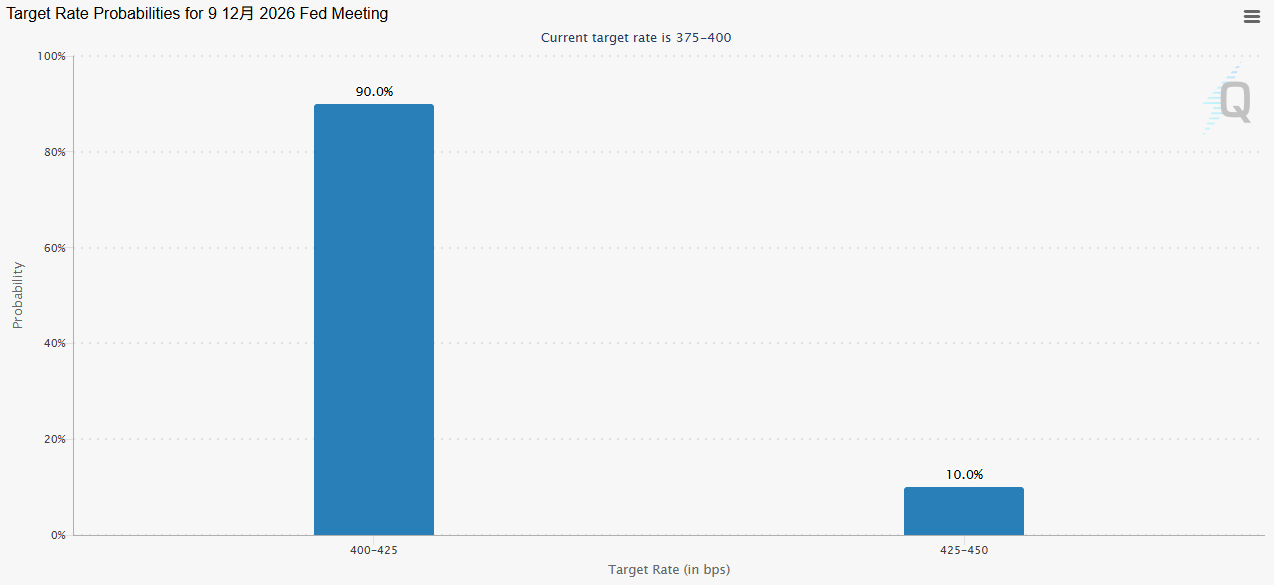
At the time of the report, CME pricing put a 90% probability on a 25-basis-point December increase and 10% on 50 basis points. It put the probability of a cumulative 50-basis-point increase by January at 75.5%, consistent with markets favoring 25 basis points at each meeting. These were market-implied probabilities, not policy commitments. BMO Capital Markets economist Scott Anderson said the October minutes strengthened expectations of two consecutive increases; LPL Financial economist Jeffrey Roach expected improving inflation readings and considered 25 basis points sufficient in December.
What the Bitcoin levels measure
Bitwise investment chief Matt Hougan attributed the earlier weekend drop near $62,000 partly to roughly $2 billion in leveraged-position liquidations during thin trading, alongside stronger-than-expected U.S. inflation. K33 research head Vetle Lunde pointed to more than half of circulating Bitcoin being held at a loss, negative perpetual-futures funding and elevated demand for options protection. Those indicators describe positioning and stress; none establishes that $62,000 is a bottom.
The 200-week moving average, which summarizes roughly four years of weekly prices, was near $68,000, according to Bitget analyst Lewis Huang. He warned that a stronger dollar and higher Treasury yields, combined with a break below the area around $62,000, could prolong selling. A moving average is a historical reference, not a barrier that must hold.
Buying demand remained a separate question. Wintermute trader Jasper de Maere saw little clear support from ETFs, crypto treasury companies, retail buyers or institutions. Talos data showed that orders within 1% above and below Bitcoin’s midpoint had fallen nearly 38% from their yearly high before the Binance theft. A thinner order book can make a given trade move the price more readily.
Longer-term charts offered conflicting readings. Fidelity’s Jurrien Timmer said Bitcoin was near a support line in his long-term price model—and that a clear break below it would test the model’s usefulness. Wellington-Altus strategist James Thorne saw a bullish weekly pattern, with $57,000 as the level that would invalidate his reading. Trader Peter Brandt instead saw a possible head-and-shoulders top whose downside implications depended on confirmation. These are conditional interpretations of past prices, not independent evidence of future buying.
For the rate outlook, the next core-inflation readings mattered. Economist Robin Brooks noted that falling oil prices had lowered inflation expectations implied by Treasury markets, while Fed officials flagged persistent core-services inflation outside housing and price pressure on some technology products from AI infrastructure demand. Improvement driven mainly by energy, rather than those underlying prices, might leave expectations of another January increase intact.